

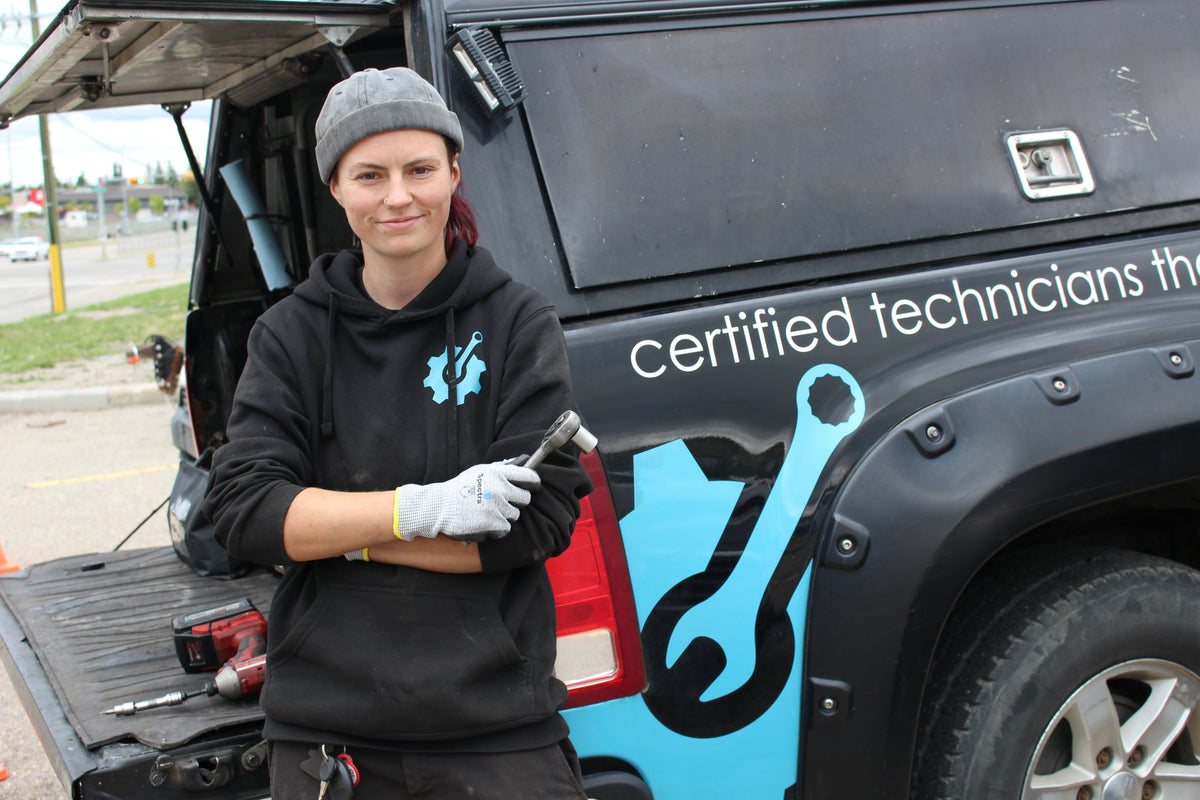
Ask a kid to draw a mechanic and you'll get the same picture every time: a guy in coveralls under a car. But walk into shops, hangars, and heavy equipment bays across Canada and you'll find women in there too. Diagnosing engines. Rebuilding transmissions. Servicing machines worth more than the building they sit in.
There aren't many of them yet. Fewer than in almost any other trade, actually. And the gear waiting for them in the shop, right down to the glove rack, was not built for them.
"Mechanic" isn't one trade. It's a dozen.
In Canada, most mechanical trades fall under the Red Seal program, the national standard that lets a certified tradesperson work in any province. Look at how many trades live under that one word:
- Automotive Service Technician, the one everybody pictures
- Truck and Transport Mechanic, keeping the highway fleet moving
- Heavy Duty Equipment Technician, working on dozers, excavators, mining and forestry machines. This one is a compulsory certification trade in Alberta.
- Agricultural Equipment Technician, on combines and tractors. Our farm readers know these folks.
- Auto Body and Collision Technician and Automotive Refinishing Technician, who put vehicles back together after the crash
- Motorcycle Technician, RV Service Technician, and Transport Trailer Technician
- Industrial Mechanic (Millwright), keeping plant and mill machinery alive
- Aircraft Maintenance Engineer, licensed through Transport Canada rather than Red Seal
Every one of these trades is hands around sharp metal, hot parts, pinch points, and chemicals, all day.
So how many women are actually in these trades?
Statistics Canada data analyzed by DesRosiers Automotive Consultants counted around 156,000 automotive technicians in Canada. Just 2.1% were women. The same analysis found a pay gap that's hard to look at: median income of $46,000 for men in the classification, $33,000 for women.
Here in Alberta, about 16,450 people work as automotive service technicians and truck and bus mechanics, and women are less than 5% of them, according to the Government of Canada Job Bank.
B.C. is worse. A study by the province's Automotive Retailers Association found women held 1% of automotive service technician jobs there, and somewhere between 0% and 12% across the six automotive skilled trades. The same report warned that up to 35% of B.C.'s technicians are expected to leave the industry by 2029, mostly to retirement.
Aviation might be the starkest of all. Only 2.8% of Aircraft Maintenance Engineer licences in Canada are held by women, per Transport Canada, and the regulator has warned that half the current AME workforce could retire by 2035.
Across the trades as a whole, the Canadian Apprenticeship Forum set a national goal of moving women's participation in construction, manufacturing, and transportation trades from 4.5% to 15% by 2030.
The mechanic trades have the widest gender gap in Canadian skilled work and a retirement wave bearing down on them at the same time. Nearly a third of automotive technicians are already over 50.
A trade that chews up hands
Nobody who's worked a shop needs convincing here, but the Canadian numbers back up what your knuckles already know.
Employment and Social Development Canada puts it bluntly: the hand is the part of the body injured most often at work, and about 500,000 hands are injured in Canada every year. Half a million. Every year.
And an injured hand keeps you out longer than you'd think. WCB Alberta data shows the average lost-time claim now costs a worker 63 days of wage-loss benefits, nearly double what it was a decade ago. WorkSafeBC reports that musculoskeletal injuries, the category that includes wrist strains and carpal tunnel, account for about 30% of all time-loss claims in that province.
For a mechanic, the hazards read like a shift description. Sharp panel and frame edges. Hot exhaust and engine parts. Spring-loaded assemblies. Rotating equipment. Brake dust, degreasers, fuel, and hydraulic fluid that dries your skin out until it cracks, then splits open on the next hard pull of a wrench.
The same government resource that counted those 500,000 injuries says something else worth repeating: hand injuries are preventable. Not rare. Not unlucky. Preventable, with hazard awareness and proper protection. In a shop, "proper protection" mostly means a glove that matches the job and actually stays on.
Now do all that in gloves two sizes too big
For women in these trades, the glove rack is where the problem gets personal. CSA Group research found half of Canadian women say their PPE doesn't fit properly, 43% find it uncomfortable, and more than a third say women-specific options aren't available at all. Not ill-fitting. Not expensive. Just not there.
And mechanical work is precision work. Threading a fastener into a hole you can't see. Feeling a torque change through a ratchet. Working a connector loose with two fingers in a gap barely wide enough for one. An oversized glove kills exactly that. Loose fingertips fumble bolts into the drain pan. Extra material snags on rotating assemblies, which is about the scariest failure a glove can have in a shop.
So women do the obvious thing: they pull the gloves off and work bare-handed. Then the sharp edges, the hot manifold, and the solvents get a clean shot at their skin.
Gloves patterned for the hands under the hood
The Women's Rockette is for the sharp stuff. Bodywork, panel and frame edges, glass, grinding prep. Anywhere sheet metal is involved, cut protection matters, and the Rockette delivers ANSI Cut Level A6 in a lightweight knit that still lets you feel what you're doing. PU-dipped palms and fingers hold oily parts securely.
Three questions before your next job
- Can you feel the work? If you keep pulling your gloves off for fine tasks, the glove is failing you. Fit or dexterity, something's wrong.
- Does the glove match the hazard? Leather for general wrenching, rated cut protection for sheet metal and glass. One glove doesn't cover a whole shop.
- Pinch the fingertips. Loose material at the tip isn't slack. Around rotating equipment, it's a snag point.
Canada needs tens of thousands of new mechanics over the next decade, and women can fill that gap. The least the industry can do is hand them gloves that fit.
Every Spectra Supply purchase supports our #GlovesForGood mission, including the Spectra Women In Trades Scholarship Fund, helping more women build strong futures in the trades. Work protected. Work empowered.
Sources: Red Seal Program (red-seal.ca), designated trades list; DesRosiers Automotive Consultants / Statistics Canada, automotive technician workforce and income data; Government of Canada Job Bank, Automotive Service Technicians occupational profile, Alberta; Automotive Retailers Association of B.C., Women in the Automotive Industry (2021); Transport Canada, AME licensing data; Canadian Apprenticeship Forum (CAF-FCA), Supporting Women in Trades National Strategy; Employment and Social Development Canada, Our Hands at Work; Workers' Compensation Board of Alberta, claim duration data; WorkSafeBC, time-loss claims data; CSA Group, Canadian Women's Experiences with Personal Protective Equipment in the Workplace.
Share:
Women Keep Canada's Production Lines Running